Dig Comics

“The Truth Is People Are Leaving Anyway”

So says DC Comics Co-Publisher Dan DiDio in last night’s Hero Complex blog. But could DC’s massive relaunch gamble this September actually halt the exodus?

According to the article, Justice League #1, the flagship title and debut issue of the massive line-wide relaunch of the publisher’s entire superhero universe, has received pre-orders asking for over 200,000 copies. Six other issues from the 52 titles shipping in September have pre-orders over 100,000 copies. That is fantastic news. Monthly comic books haven’t seen those kinds of numbers in years. There are also pending digital sales when the publisher starts releasing online and mobile versions of those same print comics simultaneously in September.

The full quote:

“The truth is people are leaving anyway, they’re just doing it quietly, and we have been papering it over with increased prices,” DiDio said. “We didn’t want to wake up one day and find we had a bunch of $20 books that 10,000 people are buying.”

Typically people from the major superhero publishers keep things pretty rosy in public interviews and online conversations. You know things must be dire when the talk gets this frank.

Another crucial observation made by DiDio:

“The walk-in, casual fans have gotten away from us,” DiDio observed. “We are down to just the die-hard buyers.”

Bringing back casual fans is the key. It’s a massive key to resuscitating sales. I’m still not completely convinced that what is getting published in September is a big enough break from the publishing and editorial strategy they’ve worked under in the past to bring in a casual readership, but 200,000+ copies is a sign I could be wrong (and I’d love to be wrong on this). Of course, it could be comic stores overestimating interest in their orders. It could only last a month or two. But for now, things are looking very promising.

If only they acted sooner. Over the weekend, a 4-store chain of comic book shops in Arizona abruptly shut down. Stores have been quietly dropping away for a while now, but this was a well-known and well-liked chain praised as a smart retailer. These weren’t the grimy comic store dungeons people avoid like the plague. But the profit margin of running a comic book store is so small that one car through your main store’s front window followed by an economic downturn and lost customers, and five years later you’re done. Atomic Comics was a big account for Diamond Comics, the industry’s primary distributor.

Would DC’s relaunch have saved them? Will it turn sales around across the entire industry? That’s a big job for one publisher, even the industry’s #2 publisher. After all, their material doesn’t cater to everyone. But if other publishers can find a way to join in the hype and fill in the gaps, we could be on to something. Hey, I’m trying to be positive here. It could happen.

#LitChat discusses Graphic Novels

The Twitter discussion thread #LitChat is covering graphic novels this week. If you’re on Twitter, jump in today and Friday, and join the conversation. It’s a great way to learn more about comics and graphic novels. The next one is today at 1:00-2:00 PM Pacific / 4:00-5:00 PM Eastern. The final one is this Friday with guest author Sean O’Reilly, publisher of Arcana Studio and co-writer of the graphic novel The Clockwork Girl (co-written by Kevin Hanna of frogchildren studios, and illustrated by Grant Bond).

#LitChat is an hour-long discussion on Twitter focused around the writing and reading of books. There’s a #LitChat every Monday, Wednesday and Friday from 1:00 PM-2:00 PM Pacific / 4-5 PM Eastern, with a guest author on Fridays.

You can find out more about #LitChat at LitChat.net and by following @LitChat on Twitter.

The Seclusion and Community of Comics

You don’t need to be an obsessive collector to enjoy comic books. You don’t need to seal them in plastic bags and put them in specially made cardboard boxes. In fact, please don’t! Comics need casual readers. Comics need a variety of consumption at all levels to return comics to a level of pop culture entertainment. Just like many people buy the occasional movie ticket, DVD, CD or video game, or download them, so too should everyone feel the urge to check out a graphic novel here and there.

But if, after sampling and casually reading, you feel the pull to dive deeper, you’ll find an incredibly engrossing and enriching world. Or worlds, really.

The Comics Reporter Tom Spurgeon recently went through a harrowing health scare that he almost didn’t survive. In fact, he’s still recovering and will be for the foreseeable future. His reflection on that time, where he thinks back on his life and life in comics, is funny and also incredibly moving. It may be a bit long, but it’s worth it. He talks about working in comics, as well as the industry and community.

I don’t think you need to be neck-deep in comics culture to appreciate what he’s talking about because it’s universal. We all belong or want to belong to a culture or sub-culture that has given us such lasting friendships and memories. Serious health problems have a way of putting things in perspective.

It’s interesting to me that this is Tom’s first real medical experience. I know several lifelong comic readers who first discovered comics as children in a hospital. A hospital bed is a lonely and isolated place, and for them, comics offered an escape and a connection to the outside world in a brand new way. You may read alone, but real human hands drew those pictures and wrote those words. Unfortunately Tom didn’t have any comics, but they were still with him after a lifetime of reading, studying, and critiquing them, and working in the industry, where he’s met and befriended countless creators and industry professionals, those real human hands that created are a part of his life. Those human hands carried Tom through a nearly fatal summer, just as those human hands carried those kids.

That’s the power of comics and the power of art.

How to do PR for Comics Right

Reed Gunther press release

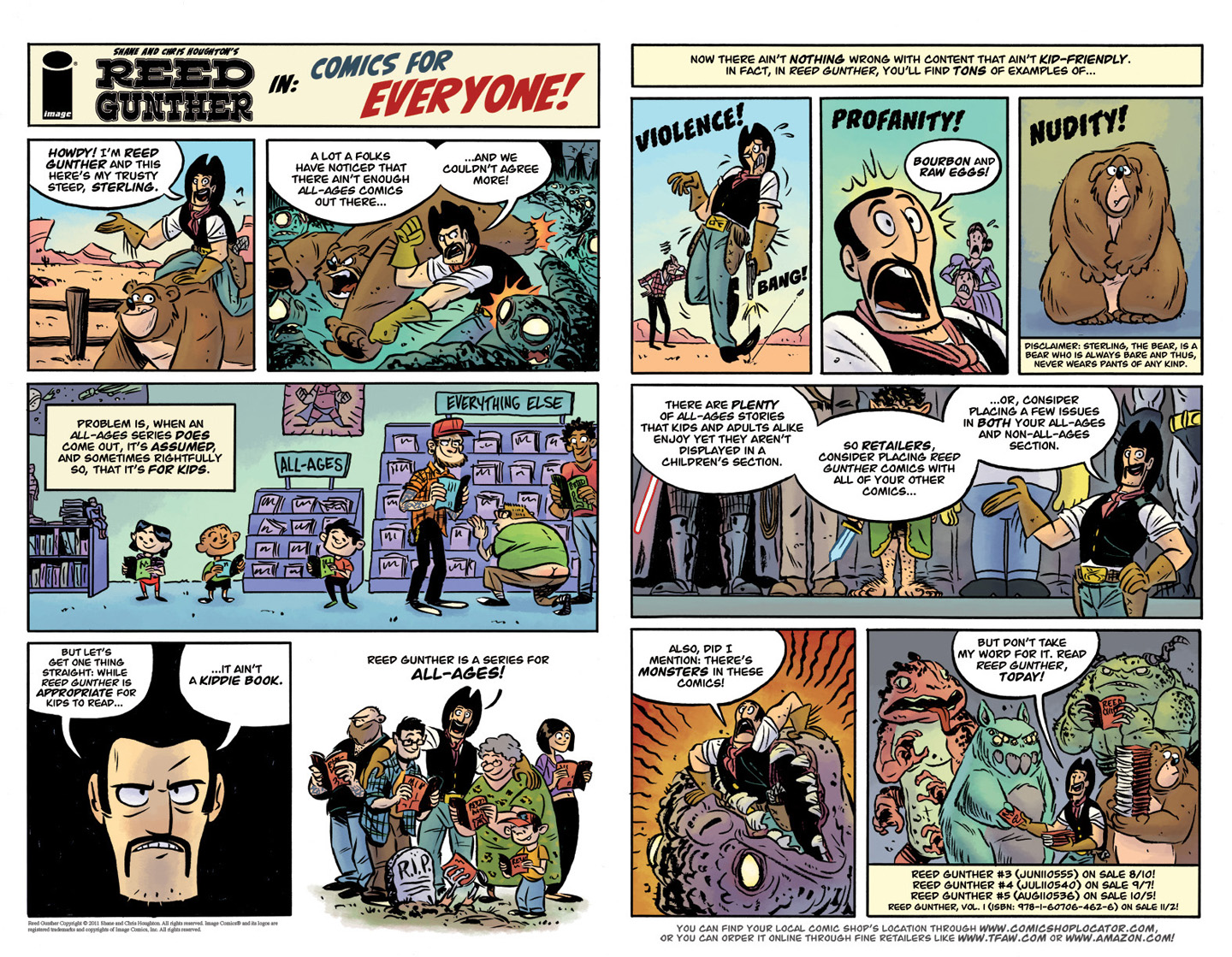
"Comics for Everyone" Reed Gunther press release by Shane and Chris Houghton (click to read)

Los Angeles siblings Shane and Chris Houghton get it. If you want to sell comics, use the powerful and appealing language of comics.

The creators of Reed Gunther issued a press release in the form of a 2-page comic that trumpets their book’s strengths as an entertaining and funny read. It also explains how their comic book series is intended for all-ages, a reading category that tends to get interpreted by retailers and readers as dumbed down kiddie stuff. The series is published by Image Comics. The press release smartly ends with a plug for ComicShopLocator.com, so that you can find your nearest shop to ask for Reed Gunther issue #3 (on sale now), issue #4 (on sale Wednesday, September 7) and issue #5 (on sale Wednesday, October 5). The first five issues will be published together in the graphic novel Reed Gunther Vol. 1, on sale November 2.

I really wish people in comics would do this kind of thing more. Use the very language that we work in to communicate about comics. How great would it be to regularly read press releases, articles, interviews, and editorials covering comics in such an engaging format? Sure it’s a bit meta. But it’s also a more effective way to show not tell when discussing the very works and topics that we’re excited about or mad about or however else we feel. It might be more time consuming but I bet the content gets better mileage. Heck, if I could draw, this site would be a blog comic.

Anyway, read Reed Gunther! The creators have been doing signings at local comic shops in and around LA. They were at Galaxy of Comics in Van Nuys yesterday for the release of issue #3. Their next appearance will be at the Wizard World: Los Angeles convention at (appropriately enough) the LA Convention Center in Downtown LA, the weekend of September 24 and 25.

Graphic Novel Reveals Real Oregon Trail

Oregon Trail

Oregon Trail: The Road to Destiny by Frank Young and David Lasky

If you grew up in the ’80s, you probably died of dysentery at least once.

Most people around my age remember that old computer game The Oregon Trail. Our school library had a few computers set up with the game just ready to go. The game has found new life in the Facebook and iPhone age.

A new graphic novel brings that historic emigrant route to life. Oregon Trial: The Road to Destiny by Frank Young and David Lasky is targeted to preteens but it’s smart enough for older readers. The authors have done extensive research into personal accounts and other historic documents to get as accurate as possible. They tell an engaging story from the perspective of a fictional 11-year-old girl whose family makes the trek from Baltimore, Maryland, to Oregon in 1848.

Young and Lasky have also begun a blog that offers great bonus material, such as photos of filthy 1848 Baltimore and how Hollywood altered history by using horses instead of oxen to pull emigrant carriages in movies about the Oregon Trail.

Amazon.com has a healthy preview of the book.

The pair is also back to work on The Carter Family: Don’t Forget This Song, a biography of the legendary country music group. The graphic novel was held up for about a year during complicated negotiations with Peermusic, the current (but apparently disputed) copyright holder of most of A.P. Carter’s song lyrics. The creators finally decided to move on without lyrics, overhauled the script, and are back at their drawing boards. But while things were tied up, they whipped up Oregon Trail. Now that’s multi-tasking.

(via)

My List of the 10 Favorite / Best / Most Significant Comics Works

Understanding Comics by Scott McCloud

Understanding Comics by Scott McCloud (the arrival of non-fiction graphic novels)

Yesterday morning, the Hooded Utilitarian posted my list along with 21 others who contributed to a giant survey of comic book creators, retailers, publishers, educators, commentators (like me) and other industry folk from all over the world to determine the 10 Best Comics. In total, 211 people responded.

I sent my list on June 15, in response to the question, “What are the ten comics works you consider your favorites, the best, or the most significant?” I started my email response to the Hooded Utilitarian with the following: “I want you to know, this is IMPOSSIBLE.”

And it is. But despite that…

My list:

Start clicking and see if something interests you.

There are plenty of comics that are just as good as the above that deserve to be listed, and even some that are better. But I had a few guidelines to help focus my list down to a manageable size.

First, I had to have actually read the material. Of the above, only Peanuts has material that I have never read. But I’ve read enough of it that what I haven’t read would have to be an absolute bomb for it to tarnish the goodwill. That means there was some material that I am fully expecting to love and that I love for its mere existence and concept that I had to leave out. I really wanted to include Carol Tyler’s You’ll Never Know on my list. It sits by my desk in my to-read pile from last year‘s Comic-Con.

Second, I leaned much heavier on the “most significant” portion of the question. As some have pointed out, the question asked by The Hooded Utilitarian is really three different questions which could result in three very different lists. Because what interests me is comics’ efforts to find new audiences, I interpreted “most significant” as the comics that have been most successful in winning over new readers. That was probably my biggest barometer. Each of the above have helped establish a genre or publishing strategy or level of skill that has expanded what comics can be and are today. In retrospect, I might’ve leaned a little too heavy on modern material but I think some of the most innovative and inclusive material is being made now (if you know where to find it).

OK, so let’s hear it. What did I miss?

(More random thoughts after the jump.)

(more…)

Marvel Comics and the Elusive Minority Demographic

Miles Morales is Spider-Man

Miles Morales is Spider-Man (art by Sara Pichelli)

While DC Comics is working through a gender controversy, Marvel Comics has taken a step forward in representing racial minorities in their super-hero comic books. On Tuesday it was announced in USA Today that Spider-Man would now be a half-black, half-Hispanic teen named Miles Morales (right).

The story is not being told in Marvel’s flagship Amazing Spider-Man (where Peter Parker is still swinging through New York City, white as ever), but instead in Ultimate Comics Spider-Man, which starts with a new issue #1 by writer Brian Michael Bendis and artist Sara Pichelli (yes DC, a woman!) in September. The Ultimate Comics imprint is set in a younger alternate universe, apart from the bulk of Marvel’s comics. Since the licensability of Marvel’s big characters, which date back to the 1960s and ’70s (and some to 1939), is dutifully protected in Marvel’s main line of comics, the Ultimate Universe allows creators just a bit more leeway. This is easily the best example of that leeway, and could be a refreshing signal of things to come for that imprint.

The first appearance of Miles Morales as Spider-Man is in the just-released Ultimate Comics Fallout #4, which itself spun out of the recent “Death of Spider-Man” story.

Bendis told USA Today, “Even though there’s some amazing African-American and minority characters bouncing around in all the superhero universes, it’s still crazy lopsided.”

He’s right, but this helps. Of course there have been plenty of foolish reactions, from anonymous internet posters trying not to sound too racist to Glenn Beck‘s weird conspiracy theory. Fortunately, cooler heads prevail, and have been celebrating what was unthinkable even five years ago. Why unthinkable? Because comic books with black leads have historically been a tough sell. The Black Panther, comics’ first headlining black hero, has had intermittent series since his debut in 1966. Todd McFarlane’s Spawn is the only comic book series to star a black or African-American in the starring role to last so long (although Al Simmons was replaced with the white Jim Downing last year). Heidi MacDonald at The Beat explores this issue and more in this well-written piece.

The Ten Best Comics

Pogo by Walt Kelly

#8: Pogo by Walt Kelly

Over 200 international comic book creators, retailers, journalists, educators, and pundits (including me!) submitted their lists answering the question “What are the ten comics works you consider your favorites, the best, or the most significant?” back in May, and now the results are getting posted at The Hooded Utilitarian.

So far, the classics Little Nemo in Slumberland by Winsor McCay, Locas stories by Jaime Hernandez, Pogo by Walt Kelly, MAD by Harvey Kurtzman and company, and Fantastic Four by Stan Lee and Jack Kirby take up spots six through ten respectively. Four and five went up this morning and the top three spots will go up tomorrow and Friday.

Then starting on Monday, they’ll start to post the top 115, as well as each contributor’s list. Once mine goes up, I’ll link to it here as well as expand on why I chose what I chose.

So far none of my choices have made the Top 10, but that doesn’t completely surprise me. The why behind my choices probably didn’t match with the majority of the other participants. But I can’t argue with what’s up there. Each entry so far is legendary for a reason. The Little Nemo write-up by Shaenon K. Garrity in particular really resonated with me, effectively capturing why Winsor McCay and his comic strip are so special.

Only occasionally has a publication or institution attempted to define a canon for sequential art (comic strips, comic books, graphic novels, manga, web comics, etc.). Literature, film and other art forms have often selected what is generally considered by most critics and fans as the height of quality and/or influence, whether it be the American Film Institute or the Great Books of the Western World.

Here are some previous entries into establishing a comic book canon:

Part of the fun of these kinds of lists is to make shopping lists and, probably more, to debate. So I’ll be taking a look at this list and how it compares with the others, looking at what I think was missed, what they got right, and the growing consensus of these lists.

DC Comics and the Elusive Female Demographic

Batgirl #1

September's Batgirl #1 by writer Gail Simone - representing DC's 1% of female creators in September

A controversy has been broiling in comics. When DC Comics announced their aggressive relaunch strategy, details were initially sparse but statements of looking for and expecting new readers were promising. Because comics needs new readers. But when the creative teams were announced, there was a decided lack of female creators and a curious dependence on creators that the publisher had relied on in the past with minimal influx of new readers.

Mainstream comics (which essentially refers to superhero comics from DC Comics and Marvel Comics) have been publishing comics primarily intended for the same insular group of readers for decades now, and finally that audience has dwindled away to a level where the publishers think maybe it’s time to somewhat kind of try to reach beyond that same audience. Multiple pundits and industry watchers have been calling for a more dramatic shift in publishing strategy for years. Comics’ most visible genre needs to be accessible and appealing to new audiences. You wouldn’t think this would require much convincing. New audiences = more money. But when large companies are given the options of safe, reliable income that is slowly shrinking vs. much more money with risks, they’ll always pick the safe option because corporate America is primarily driven by fear.

This isn’t to say that the faithful superhero comics fans can’t have their comics. Those comics should not be eliminated. They’re fun, they’re a great example of American myth building, and they have addictive pay-offs to loyalty. I still read them. Those comics should exist because there’s a built-in (albeit shrinking) audience ready to buy with a distribution network (comic book stores) structured for that specific audience. That network and that audience needs to be preserved.

But they should only be one aspect of a major publisher’s output, and they really shouldn’t be the dominant aspect when you see the ongoing sales trends. The primary concern, which should drive the dominant publishing strategy, should be new and/or casual readers, with the outcome that a percentage of those readers will transition into the addictive readers group. (They should also be distributed through other networks like bookstores and digital means, but that’s another topic.)

So, how do you get this new promised land of readers? Well, let’s look at the untapped demographics. We’ve got the white males 18-40 figured out. That primarily constitutes the addictive readers group. So good job, everyone. Check that one off the list. Let’s just check it again. Because seriously, we’ve been very thorough at targeting that demographic.

What’s an even larger demographic? How about over half of the world’s population? Yes, that demographic is out there! And it remains largely untapped in mainstream comics. That demographic is women! It’s not that there aren’t already female creators and readers of superhero comics. It’s not that there haven’t been superhero comics that reach out to women. There definitely are, but they are the exception to the rule, and they prove that there is a huge untapped sales potential.

So how do you create comics that bring in this amazingly large demographic ready to spend lots of money? The most common theory is that readers are attracted to characters that are relatable to them. People are drawn to characters that they can see themselves becoming or wish they could become. How do you have characters, either new or preexisting, that are relatable to women? The easiest way is to have another woman craft the stories (write and/or draw).

As much as we wish that everyone is the same, regardless of how they look and their genetic make-up, the world is an inconsistent place at times. People get treated differently. Groups of people get treated differently than other groups of people. Sometimes it’s really obvious, sometimes it’s very subtle, sometimes it’s imperceptible. But it all has an effect. Those experiences shape a person’s world view and it definitely shapes how they consume entertainment. I can be the most sensitive and empathic person on the planet, but I can never fully understand what living like a certain group of people day to day is like, just as other groups can’t understand what living like other groups is like. So again, the easiest way to create characters and stories that connect to a certain group you wish to attract is to employ people from that same group.

So now we come back to DC Comics and their New 52 publishing initiative. They reportedly went from having 12% of their creative teams comprising of women, down to just over 1%. For a publishing initiative intending to reach new audiences, that’s a very strange shift. You might say it’s contradictory. So people pointed this out. Some did so rather passionately because of their love for comics. People wrote online. And at this summer’s Comic-Con, people spoke up. Repeatedly. In response, DC Comics Co-Publisher Dan DiDio rather abrasively shot back with “Who should we have hired?” This, of course, just made it worse. Because when you have a Q&A portion of a panel, typically how it works is the audience provides the Q’s and the panelists provide the A’s. Making your audience uncomfortable, especially when that audience is the one you’re trying to convince to buy your products, is what you might call a bad PR move. In fact, it’s ridiculously irresponsible. And unsurprisingly, it just resulted in more attention on the issue and more heat on the publisher. Like here, here, here and here to name a few.

DC Comics finally relented when Co-Publishers DiDio and Jim Lee published “We Hear You” on their blog. Without acknowledging the embarrassing Comic-Con panels, the letter promised that female creators were in the pipeline for future projects. I suppose you could ask why female creators weren’t “good enough” to be part of the initial September launch, but at least they got the message. Finally.

And yet, I’m still seeing people online post how they don’t think people should be hired based on what they look like, they just want the best people for the job. What they don’t understand is that the uproar was never some affirmative action campaign. It was about making smart and reasonable choices to preserve and even grow comics, exactly what the New 52 was supposedly designed to be about. Because as explained above, the best people to write comics that will appeal to women will usually be women. This doesn’t eliminate male-targeted comics. And it doesn’t mean there won’t be crossover appeal because entertainment preferences aren’t strictly defined by gender alone. But it’s a no-brainer in courting a very powerful demographic that, make no mistake, comics needs.
The Comic-Con Alternative: The Non Con

The Non Con

(Logo by Ryan Fisher)

Not everyone could be at Comic-Con this past weekend. But through the magic of the intertubes, a group of web-comics creators were able to quickly set up a virtual convention for all the people not at Comic-Con. Conceived and spearheaded by Ryan Fisher of Gin and Comics, The Non Con served as a place for fans and creators to interact through live chats that simultaneously resemble Comic-Con’s panels and artists alley but with none of the traveling costs and long lines. Response was very positive, so Fisher plans to hold more non-conventions at TheNonCon.com, probably starting as soon as the first weekend of September.

The site is officially in public beta, as the site was built within 2 days before Comic-Con when Fisher got the idea. There is a slideshow currently showing off some of the artwork created by artists that attended the inaugural event. Creators and retailers can also register to participate in future Non Cons.

The live chat is particularly ingenious due to the inclusion of live video feeds integrated into the chat room. When I spent some time in there, I was able to watch two artists creating artwork for their own web-comics. It was really cool to watch. We could ask them questions and interact in a way that would be difficult on a loud convention floor. Visitors can chat either through the old fashioned keyboard or by using a microphone and/or webcam, which creates a really interesting dynamic of some people talking to silent/typed questions or comments. If you don’t want to sign up with the WordPress system they’re using (and the registration process isn’t quite the smoothest), there’s also integration with Facebook chat.

Ryan Fisher has big plans for The Non Con. There will be a few each year, with over 150-200 creators attending each one. There will be an art feed to see what is being created, as well as a schedule of panels done via chat and podcasts. There will also be a store for attending creators and retailers to sell directly to fans.

Comic-Con is a fun adventure but not anyone can travel across the country (or the world) to attend. This brings the experience of comic book conventions straight to fans, with an unprecedented level of interaction and creativity happening all at once. Sure, similar things are happening on Twitter all the time, but they’re unstructured, spontaneous, and requires people search out and follow the people they like. This preserves the crucial element of discovery that can happen at comic book conventions, where you seek out artists you know and love, and also end up finding new artists.

As big as Comic-Con has become, this has even bigger potential, as the attendance limitations are only confined to how much the site’s servers can handle. We’ll check in again come September to see how the first full blown Non Con goes.