DC Comics

Comics Events in LA: Week of 12/12/10

You don’t have to sit at home alone reading to get into comic books and graphic novels. There are always great events going on that celebrate the vitality and creativity of comics. Just here in Los Angeles, there are more events I can ever make. But I try, and so should you. You never know what you’ll discover.

Here are some local Los Angeles events coming up that celebrate the sequential art form.

This week:

Monday, December 13, 8 PM – 11:30 PM: Boom! Studios Holiday Party, where readers can mix and mingle with the Boom! Studios crew, at Meltdown Comics, 7522 Sunset Blvd., Los Angeles 90046. Tickets: $0.

Tuesday, December 14, 7 PM: Comedian Patton Oswalt moderates a discussion with writer Paul Levitz (75 Years of DC Comics: The Art of Modern Mythmaking), artist Jim Lee (All-Star Batman & Robin the Boy Wonder) and writer Geoff Johns (Green Lantern) regarding the 75th anniversary of DC Comics, at the Hammer Museum, 10899 Wilshire Blvd., Los Angeles 90024. Tickets: $0 (parking $3).

Wednesday, December 15: NEW COMICS DAY! Find your local comics specialty shop. (more…)

Copyrights and comics

As a preview to their upcoming Comic Book Comics #5 by Fred Van Lente and Ryan Dunlavey, Evil Twin Comics has posted a 6-page excerpt titled “The Grabbers”. It does an excellent job encapsulating and presenting copyright law and how it has effected the history of comic books. The piece focuses on Superman, so this is a great prequel to that BBC Superman documentary where we see Superman’s creators Jerry Siegel and Joe Shuster a few years after the events depicted at the end of this comic.

The comic also covers the legal shenanigans involving Bob Kane (Batman co-creator), Bill Finger (Batman, Robin and Joker co-creator), Jerry Robinson (Robin and Joker co-creator), Joe Simon (Captain America co-creator), and Jack Kirby (co-creator of Captain America and half of the rest of the Marvel Comics superhero universe).

What’s amazing (and kind of sad) is that a lot of these legal battles are still being fought.

BBC doc: The Comic Strip Hero (1981)

In 1981, coinciding with the UK release of Superman II starring Christopher Reeve and Gene Hackman, the BBC television series Arena broadcast this great documentary about the origins of Superman and the comics industry in general.

Plenty of good stuff here:

  • great interviews with Superman creators Jerry Siegel and Joe Shuster
  • a look inside the early ’80s offices of DC Comics with then-president Sol Harrison
  • footage of Will Eisner teaching art students who debate whether superheroes are played out
  • a pre-Maus interview with Art Spiegelman (with a GIGANTIC mustache)
  • the wonderful Trina Robbins
  • a young and charming Christopher Reeve
  • Kirk Alyn, the first actor to portray the Man of Steel, telling stories of making the Superman movie serials
  • a sputtering Fredric Wertham insisting comic books are evil, linking Superman to Nazi Germany
  • some hilarious interviews with a sci-fi guy pointing out the lack of hard science in Superman (you think?) and what would need to happen for Clark Kent and Louis Lane to have a baby (!)
  • a little kid with every licensed Superman product imaginable
  • and a frightening final moment with preserved Superman birthday cake.

It’s important to note how much the comics industry has changed since then. This is before Watchmen and The Dark Knight Returns, two superhero stories that injected new life into the genre. This was before the publication of Maus, which went on to win a Pulitzer Prize and burst open the preconceived limitations of the medium to a lot of mainstream observers. This is before comic books could be found in bookstores, before manga was introduced to US readers. Before Hollywood’s technology became affordable enough and halfway convincing enough to pull off the special effects depicted in comics. (This was almost 30 years ago?! How?!)

Click through to watch all 5 parts through the power of YouTube: (more…)

Hammer Museum celebrates 75 years of DC Comics

Hammer Museum: 75 Years of DC Comics (click for enbiggification)

The Hammer Museum here in LA reached out to let us know about a free event celebrating 75 Years of DC Comics on Tuesday December 14th at 7 PM.

Yes believe it or not, back in 1935 (!), 12 US Presidents ago, way before either Iraq Wars, before the Cold War, the Vietnam War, a few years before World War II and with the country still trying to shake off the Great Depression, a company then called National Allied Publications took a risk by publishing the first comic book of all-original material, New Fun: The Big Comic Magazine. Before then, comics were mostly or entirely made up of recycled newspaper comic strips. It was an uphill venture that initially didn’t pay off until 1938 with the release of Action Comics #1 and the debut of Superman. This was not only a huge hit, but it ended up inventing an entire sub-genre: superheroes. As National Allied changed hands, it’s name evolved to National Periodical Publications and eventually DC Comics and just recently DC Entertainment, named after the home of their second mega-hit Batman from Detective Comics. DC has remained an industry leader since the late 1930s, publishing more world icons like Wonder Woman, Green Lantern, and the Flash to accompany Superman and Batman.

Last month saw the release of a massive retrospective, 75 Years of DC Comics: The Art of Modern Mythmaking, written by former DC Comics president Paul Levitz. (Levitz was among our interviewees for Dig Comics at this year’s Comic-Con in San Diego.) To help in the yearlong celebration, Levitz will be joined at UCLA’s Hammer Museum by current DC executives and creators Jim Lee and Geoff Johns to discuss the history and future of DC. The event will be moderated by comedian Patton Oswalt, who’s no stranger to the world of comic books.

Within its short 75-year lifespan, DC Comics has created and destroyed entire cities, worlds, and universes with a cast of characters that includes the titans of the Superhero world. Comedian, actor, and writer Patton Oswalt will moderate a discussion among DC Comics’ Paul LevitzJim Lee, and Geoff Johns, the creative and editorial superheroes behind the pages of BatmanSupermanWonder WomanThe Flash and Green Lantern, who will discuss the pulp origins of DC Comics’ story lines and characters, as well as the future of digital publishing.

ALL HAMMER PUBLIC PROGRAMS ARE FREE. Tickets are required, and are available at the Billy Wilder Theater Box Office one hour prior to start time. Limit one ticket per person on a first come, first served basis. Hammer members receive priority seating, subject to availability. Reservations not accepted, RSVPs not required.

Parking is available under the museum for $3 after 6:00pm.

While this looks like fun, the really interesting part to me is the inclusion of discussing the future of digital publishing. DC has made some good moves in this area just in the last few months, but it has also sadly shut down its imprint for original webcomics Zuda Comics. Word is that some more bold moves are in the works. I’m not expecting any solid announcements, but I’m hoping there will be some positive discussion to show that they’re ready to push strongly in that direction.

And I’m also unrealistically hoping they’ll pass out free copies of Levitz’ 75 Years of DC Comics to everyone in the audience, Oprah-style.

Jack Kirby and Steve Ditko Omnibuseses on the way

Once again trolling Amazon, I’ve discovered a pair of listings for heavy duty hardcover omnibus collections of work from two seminal comic book artists and creators, Jack Kirby and Steve Ditko. Most of the material hasn’t been available since it was originally published 30-50 years ago, but next Summer we’ll have it again.

Between the two of them, Kirby and Ditko co-created (in some cases, it’s been argued they solely created) and established the core Marvel Comics universe with Spider-Man, Iron Man, the Hulk, Fantastic Four, Thor, Captain America, Dr. Strange, the Silver Surfer, the original X-Men, and many, many more.

Wait, keep your seat. This isn’t that stuff.

You see, both Kirby and Ditko worked at one time or another for Marvel’s primary competitor, DC Comics, on lesser known comics. This is that stuff.

But despite being lesser known, it’s still worth some excitement. So maybe just attentively lean forward in your seat.

You see, before Jack Kirby returned to Marvel Comics to help create the Fantastic Four, he created what many believe to be the proto-Fantastic Four, a quartet of adventuring explorers called the Challengers of the Unknown. He also worked on a Green Arrow strip, which appears to make up the bulk of The Jack Kirby Omnibus Vol. 1, according to the current product description:

In 1957, following the dissolution of his partnership with Joe Simon, Jack Kirby returned to DC Comics. Among his new assignments was the Green Arrow feature that ran simultaneously in ADVENTURE COMICS and WORLD’S FINEST COMICS, pitting the Emerald Archer and his sidekick, Speedy, against a plethora of foes.

For Steve Ditko, he left Marvel Comics in the late 1960s after an insurmountable run on The Amazing Spider-Man and trippy Dr. Strange stories, and headed to rival publisher DC Comics where he created characters like the Creeper and the duo Hawk & Dove. The Steve Ditko Omnibus Vol. 1 listing is scant on details but judging from the cover image above, the book looks to consist of his 8-issue series Shade, the Changing Man from 1977. The character and concepts were significantly revamped for an acclaimed series of the same name by Peter Milligan and Chris Bachalo in 1990, as part of the newly created Vertigo imprint, along side Neil Gaiman’s Sandman and Grant Morrison’s Animal Man.

Now you may be wondering to yourself, “What in the world is an omnibus?” And it’s an excellent question. In this instance, it’s not a type of vehicle for transporting a large number of people. Apparently it’s also a publishing term for an anthology or collection of multiple works. The comics world picked it up a few years ago. I think maybe Marvel was the first to use it for an ultra-huge hardcover collection of work that’s usually on the pricy side. It’s like a normal graphic novel on steroids. Now you know!

Print Comics: Still Awesome

My post on Monday about innovative experiments with digital comics doesn’t mean I don’t love me some dead tree comics. Print still has a lot to offer but digital means that the physical version has to step it up and offer more. Fortunately there are some good examples out there.

As a counter-point to the Johnny Cash digital graphic novel with soundtrack, there is BB Wolf and the Three L.P.’s by JD Arnold and Richard Koslowski from Top Shelf Productions. It can be purchased with a 7-song CD, BB Wolf and the Howlers: The Lost Recordings. The graphic novel spins 1920s race tension with the Three Little Pigs fairy tale. The CD brings the music of the titular blues singing main character to life, which is a very cool way to eliminate the guess work of what the music of a fictional character from a silent medium sounds like. You can also get the limited edition BB Wolf Box Set, which includes the graphic novel, the CD and a wooden box with laser engraved art on the cover and 2 shot glasses for that authentic hard-drinking blues effect.

Creating such an experience that goes beyond the pages is a compelling way to make it still matter to have print and physical product. But it doesn’t have to be about creating ancillary material. Savvy creators and publishers can find ways to have their published material be an aesthetic extension of the world they have created.

Fantagraphics Books has always excelled at this. C. Tyler‘s You’ll Never Know, both Book I: A Good and Decent Man and the new release Book II: Collateral Damage, are designed to look like scrap books or photo albums, inside and out. A visually powerful choice that is incredibly appropriate since the story centers on a woman trying to piece together her reticent father’s wartime past.

Last year, DC Comics published Wednesday Comics, an anthology of superhero and adventure stories printed on large broadsheet newsprint that folded out to 14″ x 20″ pages, approximately double the size of modern comic book pages. Reminiscent of the old Sunday comics pages from the first half of the 1900’s, it was a kick to see Green Lantern, Batman, Wonder Woman and other characters in this retro format that pre-dated nearly all of them.

There are a lot of other good examples. Some publishers, like Archaia Entertainment and Drawn & Quarterly, just have consistently great design sense in their print publications. Tumor, by Joshua Hale Fialkov and Noel Tuazon, started its life as a digital graphic novel on the Amazon Kindle, but has ended up being a great looking physical product. Chris Ware’s Acme Novelty Library books (and really any of his books) are always intricately stunning.

So sure, digital comics are the future. But that doesn’t automatically mean print comics have to be relegated to the past. There are still new and creative ways to make an appealing print comic book or graphic novel. As the ratio of print to digital finds its level ground, it will be up to creators and publishers to make products in both realms that are compelling and worth a reader’s investment.

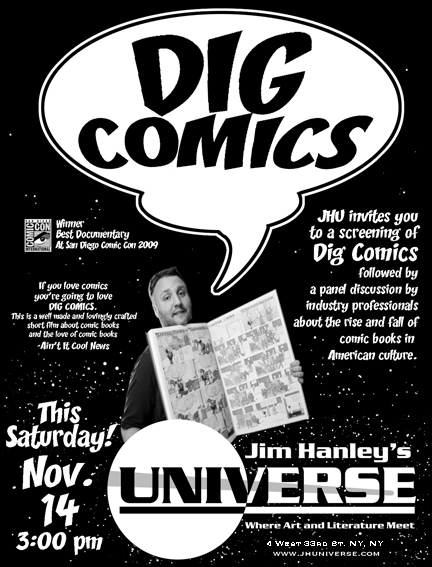
Dig Comics screens this Saturday at Jim Hanley’s Universe

Hey New York! Here’s your chance to see the documentary Dig Comics!

DigJHUweb

This Saturday, November 14, 3 PM, at Jim Hanley’s Universe, 4 West 33rd Street, New York, 10001.

Stay for an exclusive panel with director/writer/host Miguel Cima, Marvel Comics executive editor Tom Brevoort, writer/editor Andy Helfer, writer/editor Danny Fingeroth, Graphic NYC‘s Christopher Irving, and more!