Dig Comics

Happy Valentine’s Day

I’m busy pitching woo with the one I love, so to tide you over here are a bunch of comics or semi-comics pictures celebrating love and the Holiday That Hallmark Built. Enjoy!

Lois Lane debuts with Superman in Action Comics #1 by Jerry Siegel and Joe Shuster, June 1938. Clark Kent pines for Lois but she only has eyes for the Man of Steel. And the superhero genre's psychological issues with identity and romance are off and running.

Archie Comics #3, Summer 1942, art by Harry Sahle features one of comics' classic love triangles. Will Archie choose Betty or Veronica?

(more…)

Political figures understand the power of comics

They just had to use the over-played "Bam!," didn't they?

Even though comics can be challenging for some not accustomed to the language and form (as discussed yesterday), it’s still an amazingly powerful and direct form of communication. That’s why schools and libraries have embraced it as an excellent reading and educational tool. Even though the brain is processing a lot of visual information, it’s also still reading words. Apparently political figures are beginning to understand how effective their message can be communicated through comics.

This week, a joint press release announced that US Congressman John Lewis would be publishing an autobiographical graphic novel called March through comics publisher Top Shelf Productions. The Georgia Democrat will co-write with his aide Andrew Aydin, who handles telecommunications, technology and new media policy. The book, scheduled for a 2012 release, will focus on Lewis’ heavy involvement in the civil rights movement of the 1960s, of which he was a key activist. The news is historic in two respects. From the press release: “The publishing agreement is an historic first, both for the U.S. Congress and graphic novel publishing as a whole, marking the first time a sitting Member of Congress has authored a graphic novel. Top Shelf Productions is the first and only graphic novel publisher to be certified by the House Committee on Standards.”

Also, MIT economist Jonathan Gruber announced this week that he is publishing a graphic novel explaining the national health care reform package passed into law last year, according to The Boston Herald column The Pulse. Gruber is an adviser to President Barack Obama and was a major architect of both the national bill, as well as the earlier state health care reform in Massachusetts under former Governor Mitt Romney. The graphic novel, tentatively titled Health Care Reform: What It Is, Why It’s Necessary, How It Works, is scheduled for a fall release from the publisher Hill and Wang. They are the same publisher of the groundbreaking graphic novel adaptation of The 9/11 Report by Sid Jacobson and Ernie Colón, so they get that clear, concise sequential storytelling is able to present complicated information in a more digestible way. That book spawned a whole line of non-fiction graphic novels for the book publisher and others have followed their lead. Gruber’s editor Thomas LeBien told the Boston Herald, “There’s a long tradition of turning to them to take complicated information and render it accessible to the widest audience.”

He’s absolutely right. Comics have been used as government propaganda for decades, usually quite clumsy in their execution. But the more recent wave of political non-fiction comics and graphic novels use a level of craft and skill, often placing information and a compelling narrative over propaganda.

The key to getting these two newly announced graphic novels right is getting the right artist. Neither project has an artist yet. Hopefully they choose wisely.

The Ugly Truth About Comics: They’re Not Books

Batman reads a book, not expecting it to be a comic (art by Gene Ha, click for his website)

Kelly Thompson of the Comic Book Resources blog Comics Should Be Good is doing a study. She has reached out to 32 women to learn “specifically why women do and don’t read comics and what they do and don’t respond to as readers when they do read”.

You see, comics kind of have this reputation for not being all that welcoming to female readers. Maybe you’ve noticed it yourself. For a significant segment of the industry and its history, there’s good reason for that reputation. Superhero comics, often considered the mainstream of comics, are predominantly made by and for males. But for several decades there have been a growing number of comics designed to reach beyond the standard superhero demographic. And these days, the art form has never had a greater level of diversity, both in stories that could appeal to virtually anyone, and the people that make them.

Last year, Kelly did this experiment for the first time with 19 women trying out comic books: part 1, part 2, part 3. This time, she’s having 32 women try graphic novels: part 1, part 2. (Part 3 and 4 will post on the next 2 Mondays.) She gets feedback from each reader to see why they picked their comic book or graphic novel, what they thought of it, and also gets background info on their age, occupation and past experiences with comics. They’re long reads, but they’re worth it. Maybe you’ll relate to some of their responses.

It’s not a perfectly scientific study. Most of the women are progressive young women in their 20s or 30s. And they all come from Kelly’s network of friends, colleagues, and family. But I think it’s still very representative of people’s responses to comics, and some people’s resistance to comics, often regardless of gender.

One comment that came up several times was that some said they prefer to imagine visuals in prose novels than have an artist provide the visuals. I’ve heard this comment plenty of times to know that it’s not unusual. I think part of this comes from unfamiliarity with comics and the belief that reading a comic book or graphic novel should feel like reading a book, and that one should walk away from both with the same kind of feeling. But they are not the same art form or medium. This is not a 1:1 ratio.

Reading comics is not the same experience as reading novels. Even though it visually looks like you’re doing the same thing (holding a book in your hand or staring at a screen), your brain has to do different things for each medium. (And it’s important to note that “different” doesn’t mean one is better than the other.)

Despite the old myth that comics are for dummies, there’s actually a great deal of processing going on. Each panel on a page is presenting the reader with what first seems like two channels of information: words and pictures. But the two channels are permanently linked and are actually sending additional information based on how they interact with each other. The pictures aren’t simply just giving visual form to the words. The image is an artist’s vision of that chosen moment in time and each panel is rich with what I would compare with non-verbal cues when you’re talking with someone one-on-one. A character’s posture, facial expression, and clothes all provide information to the reader on a level that may never be explicitly stated. In addition, the environment that surrounds the character, the colors or lack of colors, the line weight and art style the artist is using, these all give information about the character and their world. Objects in the background or foreground that may not be essential to the story (and might not merit getting mentioned in prose) adds context to the character and his world. With prose, all of this information could be given in words, but being told about something by a writer’s carefully chosen words and seeing it through the filter of an artist’s carefully illustrated artwork are two different things. And the timing and duration of that absorption works differently. In prose, it can only be absorbed by the reader as they are reading it. In comics, all of this information can be presented simultaneously and consistently throughout an entire scene, as each panel reinforces an aesthetic or silent cue.

Another channel of information comes from the true magic of comics – sequential storytelling. Each panel creates a new dynamic between the one before and the one after it. While processing the information within each panel described above, your brain is also creating action, movement and/or the passage of time in the spaces between each panel. The brain is solving the problem of how the characters’ world changes so that everything matches up from panel to panel, moment to moment.

So all of that (and more!) is going on while you read what appears to be a simple comic book. That’s a lot of information to absorb on each panel, but fortunately the brain processes images 60,000 times faster than text. So it’s up to the task, but it might take some adjustment. Give yourself a chance to get comfortable with the language of comics before you write them off as “not books”.

CSUN teaches Superheroes Seminar

I’m short on blogging time, so I’m just going to link you to this great summary of a Superheroes Seminar that was taught by English Studies Associate Professor Charles Hatfield (author of Alternative Comics: An Emerging Literature) at CSUN Northridge last semester.

Educational institutions have been embracing comics like never before over the last decade, and it’s really exciting to me. It’s actually something I’ve been heavily looking into and reading Hatfield’s thoughts on how his first superhero-themed seminar went, and how his students responded to the material, was really fascinating to me.

The superhero genre today, and certainly superhero comics and the market that supports them, have earned their reputation for gender asymmetry; they’re lopsidedly male-dominated, and their values, with some exceptions, crushingly masculinist. I say these things not to denounce, but simply because they’re true; just as romance fiction is generally considered “for” women, superhero comics are generally considered “for” men. In any case, this gender lopsidedness represents a challenge for the genre and in teaching it. Out of the eighteen students in the course, eight were women, representing a variety of backgrounds, dispositions, tolerances, and interests, and the discussion of gender in the class, from literally the first day to the last, was a vital part of our conversations.

BREAKING: Newsstands still exist, kids still read comics

This just in: Print Still Happens! (Click for bigginess)

Amid all the attention put on digital, its exclusive contract with the future, and the “print is dead” mantra, it’s refreshing to be reminded that kids can still be completely entertained by a comic book made of dead trees and staples at their local newsstand.

The Los Angeles Times has a Southern California Moments site that highlights a local photo of the day. This picture, titled “Fully engaged,” was selected for January 25. It was taken by user bobcov1 on September 9, 2010. The kids sit at King’s Newsstand, located at 8361 Beverly Blvd. at Kings Road. It’s named after its neighbor Kings Road Café, although I’m not sure which was there first. The boy on the right is reading a comic book although I can’t tell which one. His brother (presumably) seems to be reading a magazine, another form of print that’s becoming more and more rare in this ever-increasingly app-powered world.

The photo’s caption reads, “Two young boys, clearly aware that life exists beyond Gameboy, entertain themselves the old-fashioned way.” Game Boy. How quaint. (Nintendo DS, maybe. Or the PSP.)

It’s easy to forget that outside of major cities, newsstands have become a rare sight, but Los Angeles actually has a ton of them. In fact there’s one a few blocks away from me on the corner of National and Sepulveda that I could probably walk to in about ten minutes. (Incidentally, there’s a pretty crummy comic book store in the strip mall kitty-corner to it that I’ve finally given up on.)

According to Yelp, there are over 1,000 newsstands in the greater Los Angeles area. It would be interesting to see what kind of presence comic books have in these newsstands, and what kind of sales they generate. I mean, does anyone actually still buy comics at their local newsstand? Here’s the photographic proof that says they do.

(Via The Beat)

LA’s All-Star Comic Creators Team-Up

LA Comics Creators (left to right): Johnny Ryan, Jaime Hernandez, Ron Regé, Jordan Crane, Sammy Harkham, Frank Santoro (click for Comics Comics article)

Some of Los Angeles’ finest and most innovative sequential storytellers met up for dinner recently, and Frank Santoro of Comics Comics was there. Part one was posted last Saturday and part two should be coming this weekend. It’s a fascinating look at the comics community of Los Angeles with interesting observations about the storytelling style of these local artists. Santoro is an acclaimed artist himself, and in fact his arrival in town for a gallery exhibition of his work at Dem Passwords in West Hollywood (still happening until February 18th) was the impetus for the epic meeting.

So who made up the all-star lineup?

Jaime Hernandez makes up one third of the legendary Los Bros Hernandez, creators of the hugely influential Love and Rockets, a series that revolutionized the alternative comics scene in the ’80s. The rich characters Jaime and Gilbert Hernandez created in that series continue to this day in the annual publication Love and Rockets: New Stories. Jaime’s primary narrative grew out from the California punk scene of the time and his home town of Oxnard, about an hour or so east of LA. As you’ll see from the article, Jaime is greatly revered by Santoro, and for good reason because of the high caliber of his work and the trailblazing he did in the industry almost 30 years ago. It’s entirely possible that without him, the rest wouldn’t be doing comics, or if they were, their work would look significantly different and possibly never make it to our hands.

Sammy Harkham is the editor of Kramer’s Ergot, one of the most acclaimed comics anthologies of the last 10 years. He is a respected artist himself, his current work is his series Crickets. He also co-owns the comics and book store Family on Fairfax in West Hollywood. The shape of the sector that is often called literary comics, art comics and/or alternative comics would look a lot different today without him.

Ron Regé, Jr. is, like me, originally from Massachusetts and now lives in Los Angeles. So basically we’re the same person. Except that he’s created amazing artwork that explores colorful dreamscapes like Skipper Bee Bye and Yeast Hoist. He’s apparently working on a new release that sounds amazing. Regé is also a musician, currently playing drums for the LA-based country/folk/psychedelic Lavendar Diamond.

Johnny Ryan is a mad man. Also originally from Massachusetts, he is responsible for reinvigorating humor comics with a brash and often shocking energy, in Angry Youth ComixPrison Pit, and his work for VICE magazine. Definitely a lot of NSFW, and he’s not for everyone, but I think he’s hilarious. He’s one of the few people carrying the torch of the underground comix of R. Crumb and others.

Jordan Crane is a wonderful artist perhaps best known for The Clouds Above, a delightful children’s story. But he has also created some heartbreaking, simply beautiful stories, such as The Last Lonely Saturday, a poignant tale of an old man visiting his late wife’s grave. The latter is seen in our documentary short Dig Comics, and won over a self-proclaimed book snob and English major who thought comics were just violence.

All of these artists are unique creators to be treasured. Check out the links above and discover stories you didn’t even know you were missing.

Vote Best Comics for CityVoter LA’s Hotlist

Collector's Paradise - Currently at 1st place

CityVoter LA has posted online ballots to determine their LA Hotlist for 2010. They’ve been doing this since 2007 and this year there’s a Best Comics category. Oh how far we’ve come!

Collector’s Paradise in Winnetka has been appealing to their customers to vote for them, and so far it’s paying off. They’re at 1st place right now, followed by Metropolis Comics in Bellflower for 2nd and Njoy Games & Comics in Northridge has 3rd place. Other nominees include The Comic Bug, House of Secrets, and Golden Apple Comics. If your favorite store isn’t listed, you can also do write-ins.

Comic shops also pop up in other categories. Best Art Gallery has three comics-related nominees: comic shops Meltdown Comics and Collectibles and Secret Headquarters both have galleries, and Every Picture Tells A Story specializes in comics art. Hi De Ho Comics is running in the Best Bookstore category.

As an added incentive, voters are entered into a $10,000 Staycation Sweepstakes.

Voting ends March 18. Winners will be announced March 25.

Top Cow reorganizes

Teaser for new Top Cow series Netherworld (click for preview)

It’s been a rough first month of 2011 for comics in general, with good and not-so-good news turning heads throughout the industry as the times continue to change. There’s been some adjusting locally too.

Top Cow Productions, a partner studio of Image Comics, announced during my week of computer meltdown that a reorganization has taken place. The LA-based publisher will consolidate its resources to more closely rely and coordinate with Image’s central office in Berkeley. From the press release: “Image Central will work more closely with Top Cow to coordinate production, marketing and sales efforts in much the same way it already does for the other Image partners.” Publisher Filip Sablik stressed that Top Cow would retain their editorial freedom. Heidi MacDonald’s The Beat looked into this further here and here.

While the hope is that Top Cow will be able to benefit from some of the successes Image has seen recently, such as The Walking Dead‘s continual rise in popularity thanks to the AMC TV show and new hits like Chew and Morning Glories, it doesn’t mean good times for everyone. Unfortunately some people from Top Cow were let go to eliminate new redundancies from the closer partnership, such as PR and Marketing Coordinator Christine Dinh, Director of Sales and Marketing Atom Freeman and Editor/Designer Phil Smith. Freeman, an award-winning retailer who co-owns the comics shop Brave New World Comics in Newhall, was hired as Direct Market Liason last summer and promoted to Director of Sales and Marketing this past October. No word yet on what’s next for Dinh and Smith, although at least Smith is helping with the transition. Sablik has stated that now other layoffs are planned. At Image Comics, PR and Marketing Coordinator Betsy Gomez has been replaced by Sarah deLaine.

Top Cow President Matt Hawkins bluntly told The Beat, “There’s going to be more consolidation (like Image and Top Cow) and some people won’t be around in a couple years”.

Just prior to that news, Top Cow announced they had signed artist Jeremy Haun (Detective Comics) to an exclusive contract. Haun, who has worked on Top Cow’s Alibi and Berserker, has been assigned to The Darkness with writer Phil Hester, one of Top Cow’s biggest properties. The book was a massive seller in the ’90s where it had a record-selling 11 variant covers for a single issue. Haun will also have the ability to develop new original properties. On his site, he explained that the contract goes into effect February 2011 (so, tomorrow). In explaining the reasons for his decision, after being a freelance artist for years, he said, “The major ones where working as a regular artist on a continuing series and almost more importantly, being able to develop my own concepts.” As he points out, Haun has written Narcoleptic Sunday for Oni Press and a story in Image’s award-winning Comic Book Tattoo anthology based on the music of Tori Amos, so he does have some writer chops. And more original creator-owned comics is always a good thing in my book.

Top Cow Productions started in 1992 as the studio for Image Comics co-founder and partner Marc Silvestri. Throughout the decade, they grew a line of successful fantasy comics like The Darkness, Witchblade and others guided by Silvestri’s distinct art style that defined the look of the publisher for many readers. The publisher has struggled to shake that perception over the last ten years, and have been pushing their attention to more creator-owned books such as the new thriller Echoes by Joshua Hale Fialkov and Rahsan Ekedal, and the upcoming supernatural noir Netherworld by co-writers Bryan Edward Hill and Rob Levin, and artist Tony Shasteen. Hill and Levin have both worked for Top Cow in the past, last collaborating together on Broken Trinity: Pandora’s Box. MTV’s Geek News has a preview of Netherworlds.

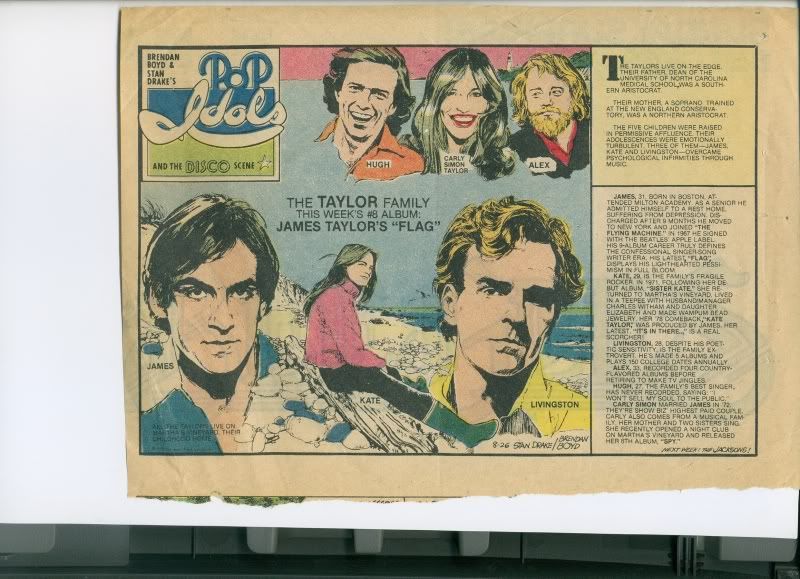
Stan Drake draws James Taylor, Carly Simon and family

Combining comic books and some of my favorite musicians? Yes please!

In 1979, comic strip artist Stan Drake illustrated this profile of folk rock singer-songwriter James Taylor and his four siblings, folk/pop singer-songwriter Livingston Taylor, singer (and now songwriter) Kate Taylor, southern blues singer Alex Taylor, and singer (and now inn keeper) Hugh Taylor. Also included in the profile is James’ then-wife pop rock singer-songwriter Carly Simon. The text was written by Brendan Boyd.

Click for bigginess

The piece originally ran in The Star-Ledger of Newark, New Jersey, as part of their Pop Idols series of illustrated profiles, which appeared in the comics section. As you can see in the bottom right corner, The Jacksons were next week’s featured artists. According to the Lewis Wayne Gallery, which has original art for sale for the strips on Jimi Hendrix, the Talking Heads and John Travolta, Stan created the strip.

Stan Drake did an excellent job. James and Livingston in particular are spot on. Although the colorist got a little sloppy with Carly’s lipstick. And kind of strange that Carly, just as major an artist as James, is in the inset and mentioned last in the profile text on the right. I guess because it’s focusing on the Taylor siblings? And what’s with Alex secretly checking out Carly? At least Hugh is having a good time.

I assume the Brendan Boyd that wrote this is not Brendan Boyd of Incubus, as that would’ve made him about 3 years old at the time. Although the thought of alt-rocker Incubus’ front man writing about sensitive singer-songwriters from Martha’s Vineyard is pretty amusing.

For way too much context and back story on Stan Drake, James Taylor, Carly Simon and the other Taylor siblings, click through…

(more…)

The [spoiler] of [spoiler] [spoiler] from Fantastic Four

Everyone is talking about how [spoiler] [spoiler] from the Fantastic Four [spoiler]ed. Click through for the de-[spoiler]ing info and my thoughts. SPOILERS coming… (more…)