Marvel Comics

Diversity is the key

Marvel Comics announced details late last week of the launch of a new imprint that will focus on genres other than superheroes. Marvel’s CrossGen line will cross into genres not typically associated with the publisher of Spider-Man, Iron Man and Captain America.

Outside of their Marvel Illustrated line of comics adapting classic novels like the Wonderful Wizard of Oz, Pride and Prejudice and Treasure Island, more modern adaptations of Stephen King’s Dark Tower and Laurell K. Hamilton’s Anita Blake, Vampire Hunter, and other sporadic attempts here and there, this is the first concerted effort to reach outside of their known superhero material since the publisher was releasing westerns and monster comics in the 1960s.

The CrossGen imprint is actually a resurrection of a publisher that failed and was purchased by Marvel’s new parent company Disney in 2004. CrossGen Entertainment came onto the comics scene with some daring moves. Instead of relying on freelancers, CrossGen relocated their talent to the company’s Florida compound and provided them with a salary, health insurance, 401k and other benefits largely alien to most creative types in the comics industry. They also were among the first to aggressively reprint their comics every 6 months or so in soft cover graphic novels (or “trade paperbacks”) targeted to book stores, now an industry standard. They were the first publisher to experiment with digital comics, with an online portal similar to Marvel’s Digital Comics Unlimited service. They also had a school and library outreach program with some of their material available in special lesson plan editions. Unfortunately CrossGen didn’t survive long enough to see these distribution channels mature to the point they have in the last 5 years and the company’s chutzpah ended up burying it.

Considering some of the trash talk thrown out by CrossGen’s president when the company was on the rise, it’s almost too ironic that its properties are now being published by Marvel. Still, the company put out some good looking books. They had a knack for attracting strong talent and putting out quality books that filled niche holes in the industry at the time. And now Marvel is using those properties to expand their line into new areas, a long overdue move that major competitor DC Comics knew to do back in the ’90s with the creation of the Vertigo imprint (even if it has typically limited itself to more mature readers content).

But with the struggling economy, is now the time to launch new initiatives? Marvel is keeping things modest with just two 4-issue series priced at $2.99 (versus their nearly standard $3.99 cover price). And they’re putting worthy talent in place to help garner interest. Mark Waid (Kingdom Come, The Flash) remains a hot writer, and is actually getting a second go at Ruse (pictured above), a Sherlockian mystery set in Victorian England. Mike Carey (Lucifer, The Unwritten) will write the more overhauled Sigil, a sci-fi war epic.

Initial response seems positive so far. CrossGen garnered an enthusiastic cult following in its day. (Disclaimer: I loved them.) And based on online responses so far, most seem eager to see these books return. Of course as we’ve seen, online enthusiasm doesn’t always translate into sustainable sales. But then sometimes it does.

When comics’ largest publisher launches an imprint that brings more diversity in their line of books, it can’t not be a good thing. Hopefully execution will match the good news. Hopefully retailers and readers will embrace the books. Time will tell.

The two new books are scheduled for a March 2011 release.

Copyrights and comics

As a preview to their upcoming Comic Book Comics #5 by Fred Van Lente and Ryan Dunlavey, Evil Twin Comics has posted a 6-page excerpt titled “The Grabbers”. It does an excellent job encapsulating and presenting copyright law and how it has effected the history of comic books. The piece focuses on Superman, so this is a great prequel to that BBC Superman documentary where we see Superman’s creators Jerry Siegel and Joe Shuster a few years after the events depicted at the end of this comic.

The comic also covers the legal shenanigans involving Bob Kane (Batman co-creator), Bill Finger (Batman, Robin and Joker co-creator), Jerry Robinson (Robin and Joker co-creator), Joe Simon (Captain America co-creator), and Jack Kirby (co-creator of Captain America and half of the rest of the Marvel Comics superhero universe).

What’s amazing (and kind of sad) is that a lot of these legal battles are still being fought.

Jack Kirby and Steve Ditko Omnibuseses on the way

Once again trolling Amazon, I’ve discovered a pair of listings for heavy duty hardcover omnibus collections of work from two seminal comic book artists and creators, Jack Kirby and Steve Ditko. Most of the material hasn’t been available since it was originally published 30-50 years ago, but next Summer we’ll have it again.

Between the two of them, Kirby and Ditko co-created (in some cases, it’s been argued they solely created) and established the core Marvel Comics universe with Spider-Man, Iron Man, the Hulk, Fantastic Four, Thor, Captain America, Dr. Strange, the Silver Surfer, the original X-Men, and many, many more.

Wait, keep your seat. This isn’t that stuff.

You see, both Kirby and Ditko worked at one time or another for Marvel’s primary competitor, DC Comics, on lesser known comics. This is that stuff.

But despite being lesser known, it’s still worth some excitement. So maybe just attentively lean forward in your seat.

You see, before Jack Kirby returned to Marvel Comics to help create the Fantastic Four, he created what many believe to be the proto-Fantastic Four, a quartet of adventuring explorers called the Challengers of the Unknown. He also worked on a Green Arrow strip, which appears to make up the bulk of The Jack Kirby Omnibus Vol. 1, according to the current product description:

In 1957, following the dissolution of his partnership with Joe Simon, Jack Kirby returned to DC Comics. Among his new assignments was the Green Arrow feature that ran simultaneously in ADVENTURE COMICS and WORLD’S FINEST COMICS, pitting the Emerald Archer and his sidekick, Speedy, against a plethora of foes.

For Steve Ditko, he left Marvel Comics in the late 1960s after an insurmountable run on The Amazing Spider-Man and trippy Dr. Strange stories, and headed to rival publisher DC Comics where he created characters like the Creeper and the duo Hawk & Dove. The Steve Ditko Omnibus Vol. 1 listing is scant on details but judging from the cover image above, the book looks to consist of his 8-issue series Shade, the Changing Man from 1977. The character and concepts were significantly revamped for an acclaimed series of the same name by Peter Milligan and Chris Bachalo in 1990, as part of the newly created Vertigo imprint, along side Neil Gaiman’s Sandman and Grant Morrison’s Animal Man.

Now you may be wondering to yourself, “What in the world is an omnibus?” And it’s an excellent question. In this instance, it’s not a type of vehicle for transporting a large number of people. Apparently it’s also a publishing term for an anthology or collection of multiple works. The comics world picked it up a few years ago. I think maybe Marvel was the first to use it for an ultra-huge hardcover collection of work that’s usually on the pricy side. It’s like a normal graphic novel on steroids. Now you know!

Mark Millar’s Trouble: Pedophilia the Marvel Way

Some geek scouring of Amazon revealed a listing for a hardcover collection of the 2003 Marvel Comics mini-series Trouble by Mark Millar and Terry Dodson scheduled for release on June 8, 2011. Yup, that’s the cover of the first issue from 2003. Classy, no?

Mark Millar has made a significant name for himself, most notably to the public at large for being the creative mind behind the Hollywood movies Kick-Ass and Wanted, both based on comic book mini-series he wrote (the former with artist John Romita, Jr., and the latter with J. G. Jones). (Terry Dodson is also a pretty popular comics artist, having worked on characters like Spider-Man, Wonder Woman and the X-Men.) So it makes sense for Marvel to mine its back catalog for material with Millar’s name on it. But I have to admit I never thought this comic would ever see the light of day again.

The concept is that Spider-Man’s Aunt May and Uncle Ben, while teenagers and not yet married, go on a double date with Spider-Man’s future parents to a resort in the Hamptons for summer vacation. It’s never explicitly stated that’s who they are (no last names are ever given), but the intent is pretty obvious. The story soon turns into a very special episode dealing with teen pregnancy.

As if that wasn’t blasphemous enough for longtime Spider-Man fans, Marvel inexplicably decided that instead of comics art on the covers, each of the five issues should use uncomfortable pictures of young girls in bathing suits, like the one creeping you out right now. The idea was to have French photographer Phillipe Biabolos mimic the covers of romance novels in an effort to draw in female readers. Idea and execution don’t always stay on the same path.

You see, this comic was supposed to help resurrect the long stagnant romance genre in comics, which was huge in the late 1940s and early 1950s, bringing in tons of female readers. But in 1954 the comics industry felt pressured to create a self-censorship board following some heated Senate hearings on the dangers of comics to America’s youth. So romance comics became boring and people stopped reading. By the 1970s the genre was dead. Flash forward to 2003, and Marvel Comics realizes that drawing from a demographic consisting of just over half the population could be a pretty good strategy. So they decided to give romance comics a go again. And then proceeded to royally botch it up with creepy covers of possibly under-age girls and an unnecessary connection to Marvel’s superhero mascot.

The series, conceived and written entirely by men who work almost exclusively in the superhero genre, failed to find an audience in comics shops. Many of those stores had very likely never tried to sell a romance comic before. And let’s be honest, they had an uphill battle. I have a hard time imagining someone who would be interested in romance comics feeling comfortable buying something with that cover. It’s got Pedobear written all over it.

As you might expect, it was lambasted by readers and drew a lot of critical ire at the time. In fact, it faired so poorly that the softcover collection of the individual issues, which would have been distributed to bookstores so female readers might actually discover it, was cancelled. Who knows? Maybe book stores took one look at it and refused to carry it. Regardless, the aborted graphic novel seemed to be an unspoken message of “Forget it. It never happened.”

And yet, here it comes again. Has it aged well? I guess we’ll find out. I’d love to hear Mark Millar or Terry Dodson’s thoughts on the comic now with some time passed. Marvel Comics Editor-in-Chief Joe Quesada and former Marvel publisher Bill Jemas were also heavily involved in the concept and design of the comic, so I’m curious about their thoughts as well. Any regrets? Any realizations that maybe this could’ve been pulled off better? Or did everyone just overreact and misread everything?

(It should be noted that sometimes these super-advanced Amazon listings end up being completely wrong. So it’s entirely possible this never comes out. But it’s a good excuse to revisit this failed attempt at reaching female readers. Quite a few major comics publishers have plenty of examples. And sometimes they even get it right.)

Motion Comics: Not Comics, Barely Motion

Since my dismissive comment about motion comics, I’ve received tons and tons of hate mail. OK, perhaps I exaggerate. Perhaps I made that up completely. In reality, not one person living or dead made a single comment about it. So either everybody was so enraged, they couldn’t focus enough to write a response, or everybody silently agreed. Or more likely, most people have never even heard of motion comics, never mind knowing enough to form an opinion.

If you are in that last group, you’ll be able to catch up pretty quickly because motion comics are still in their infancy. Put simply, motion comics are adaptations of comic books and graphic novels that use computers to animate the original comic artwork (or recreations), and then replaces the written word with voice actors, music and sound effects. Put way simply, it’s a mini-cartoon based on a comic.

While stylistically more slick, they are basically the old Marvel Comics cartoons from the ’60s.

But they’re not without their fans. The appeal and idea of motion comics is that it brings to life your favorite comics. It’s typically very faithful in look and story because they’re pulling straight from the original comics.

The downside is that the animation is really limited because they’re trying to animate static images that were only ever meant to represent movement, not actually depict movement.

My main problem with them is that they really aren’t comics at all. The comic book industry and art form has been stuck with inaccurate terms for decades upon decades. Comic books aren’t necessarily comical; they more resemble magazines than actual books. Graphic novels aren’t necessarily graphic in content but do use graphic design and imagery; they don’t have be a long narrative like novels. So I suppose adding one more misnomer to the pile shouldn’t matter.

But it’s worth noting: motion comics are not comic books. They do not use the language of comics. They use the language of motion pictures (film, animation, etc.).

This past weekend at King Con in Brooklyn, Act-I-Vate founder and writer/artist Dean Haspiel debuted his attempt at a motion comic with Billy Dogma in “Sex Planet” [warning: adult content, so I won’t embed it here]. His goal seemed to be to include more of the language of comics while pulling back some on the animation. That’s a direction that interests me more than the above example but the finished product is mixed. The voice acting is lacking (Haspiel himself provides the voice of Billy Dogma) and there’s a weird timing issue with having finished read the text and waiting for the actors to catch up, but there are some cute visual gags that have well-timed reveals. See The Beat for more on this.

Clearly motion comics are just getting started. So, “To Be Continued…”

Uh oh. My marriage might be official again.

Over two years ago (!), Marvel Comics had a goofy story in Amazing Spider-Man where a devil-like demon called Mephisto basically erased Peter Parker’s marriage to Mary Jane Watson. They had been married for 20 years and just like that it was gone. Comic geeks across the world were outraged.

Not to be left out of the indignation, in an act of fever-induced inspiration I announced the erasing of my own marriage in protest. Both Spider-Man and I have been web-swinging bachelors ever since. (Yes, I can make webs. What of it?)

Well it looks like the gig might soon be up. Marvel Comics released a publicity image for a Spider-Man story to take place some time this year, and it looks like the marriage might live again. If so, I guess I’ll have to get “re-married”. Bummer. And I was having so much fun with my communicable diseases.

See, this is what’s great about superhero comics. If something stupid happens, just wait a year or so and it’ll be undone. Character arcs are for chumps.

(Click here to look at the enbiggified version at Comic Book Resources)

(Wait a minute, is that a baby in the background? Oh yeah that’s right. In the ’90s, Peter and Mary Jane had a baby who mysteriously vanished in some weird plane hijacking incident. Both parents got over it real quick because Marvel figured superhero fans might get bummed out reading about mourning parents for a few years.)

Your Brad Link of the Day – WebStrip condones Superhero Cougar

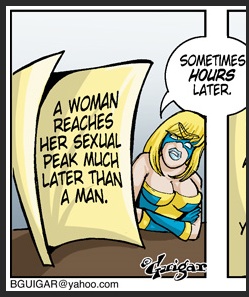
The web-strip Evil, Inc. by Brad J. Guigar had an amusing strip for December 11, which kicked off a new story line currently running.

My Google Chat conversation with Brad reacting to the comic:

me:  Heh.

Brad:  Yes. Just – heh.
But remember, that’s one letter better than eh.

Truer words were never typed. Click on the image or the link above to read the entire comic.

Also amusing is the timing of when he sent me this link. I was reading yesterday’s news of Marvel Comics’ condescendingly-titled yet well-meaning Girl Comics anthology planned to celebrate Women’s History Month in March 2010. (If you dare, read the comments under that article.)

I’m sure someone could make an extremely clever observation about the juxtaposition of these two items and what they say about women in comics. On a day with more sleep, I might even attempt to be that person. But I think I’ll let them speak for themselves. Juxtapose away, items!

Your Brad Link of the Day is provided to me by my friend Brad Beacom via Google Chat. It may or may not actually occur on a daily basis. You may or may not have already seen it. (But in those instances, some classics are worth revisiting.) You may or may not find some enjoyment in it. Essentially, I take no responsibility for anything.
Also, thanks for your PhotoShop magic, Brad.

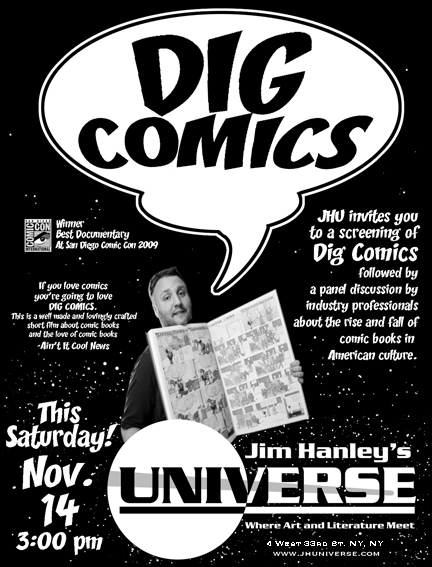
Dig Comics screens this Saturday at Jim Hanley’s Universe

Hey New York! Here’s your chance to see the documentary Dig Comics!

DigJHUweb

This Saturday, November 14, 3 PM, at Jim Hanley’s Universe, 4 West 33rd Street, New York, 10001.

Stay for an exclusive panel with director/writer/host Miguel Cima, Marvel Comics executive editor Tom Brevoort, writer/editor Andy Helfer, writer/editor Danny Fingeroth, Graphic NYC‘s Christopher Irving, and more!

Liked Iron Man? Be a Hero and Help Out

So, how ’bout that Iron Man movie? Pretty cool, huh? You bet it was!

It’s, like, totally over 90% fresh on Rotten Tomatoes. It MUST be awesome.

It is so totally the best superhero movie ever in the history of ever since ever first started.

Way.

Yeah, it was tons of fun. You know what’s not fun? Liver failure.

Sorry, I know. Bummer seque.

Sadly, one of the comic book artists that made Iron Man so memorable for hundreds of thousands is suffering. His name is Gene Colan.

Yes, yes. Funny last name. Go on, get it out of your system. I’ll wait.

(*snicker*)

Yes, okay, where were we? That’s right, Gene Colan.

In late 1965, Gene Colan took over drawing the Iron Man stories in an anthology comic called Tales of Suspense. He replaced Iron Man co-creator and artist Don Heck, who is credited in the Iron Man movie along with fellow Iron Man creators Stan Lee, Larry Lieber (Stan Lee’s younger brother) and Jack Kirby. Gene Colan’s time with the character proved so popular, that in 1968 the character graduated to starring in his own comic book series, The Invincible Iron Man.

Gene Colan also had a significant run of drawing Daredevil in the mid-1960s to early-1970s, but most people don’t really have fond memories of the Ben Affleck movie, so we’ll just gloss over that part. He also made his mark on Howard the Duck, which was an even worse movie, but the comics were great satire.

Anyway, on May 10th, writer Clifford Meth announced that Gene Colan was sick and because people in comics back in the 1960s and 1970s didn’t get health insurance or 401K plans or anything else beyond a simple flat rate per page, Gene and his wife are facing immense medical bills. As the Iron Man movie rakes in over $200 million worldwide, it seems a shame that some of that financial gratitude can’t be passed on to one of the first artists to portray the character. Without his hard work and talent, it’s possible the character never would’ve lasted long enough to make it to the big screen. So, if you would like to help out in some small way, there are a few ways you can help:

  1. Donate to The Hero Initiative – This not-for-profit organization exists for the sole purpose of helping establish a safety net for comic creators like Gene Colan who did not financially benefit from the success of the comics and characters they worked on. And there are many. Make a donation and ask that your contribution be directed to help out Gene Colan.
  2. Bid on a fundraising auction item – Writer Clifford Meth has begun an auction to help raise money for Gene Colan. The auction started today and includes (or will include) lots of fun stuff by Stan Lee, Harlon Ellison, Neil Gaiman, Gene Colan himself, and lots of others.
  3. Buy cool Gene Colan stuff – Marvel Comics and The Hero Initiative have teamed up to help raise money for Gene Colan. If you’re going to any comic book conventions this summer (I’ll be at Comic-Con in San Diego), be sure to look for limited edition art prints. Additional Gene Colan-themed items will be released by Marvel in August and September.

Okay, that’s my spiel. And if you haven’t seen Iron Man yet, go see it!

If Spider-Man is no longer married…

Late last year Marvel Comics released a storyline in their flagship Amazing Spider-Man comic book series that clumsily erased Peter Parker’s 1987 marriage to Mary Jane Watson. All sorts of geek outrage ensued at the time. I guess it sort of still rages. The whole thing was rather silly but hey, them’s comics. But sometimes you don’t really care enough until it effects you personally.

Last week, while lying in bed wishing I was dead from a pretty tough cold, I noticed two red boxes on top of our bedroom bookcase. I had almost forgotten about them. And then it all came falling into place in typical comic book melodrama.

The two red boxes each held one doll (or “action figure” if you prefer) of Spider-Man and Mary Jane from their comic book wedding originally depicted in The Amazing Spider-Man Annual #21. The dolls were gifts. The occasion for the gifts? My wedding.

And now… looking at the dolls… and knowing that their wedding never really happened… it feels like my own wedding didn’t happen. November 10, 2006 was the happiest day of my life. But now… it just feels like an empty lie.

And that’s why, as of now, I’m single again. That’s right, if Spider-Man is no longer married, then neither am I.

I know this is probably an awkward way for everyone, including my wife – er, my girlfriend – to find out, but I thought it was the best way to get the word out, especially considering the late notice. Technically, this will be retroactively in effect since December 28, 2007, when the offending issue was originally released.

I hope all of the people at Marvel Comics will think long and hard about the next relationship they destroy.

I’d like to thank my flu for helping me see the light before it was too late.